
Croissant online class with Yohan Ferrant
Laminate a croissant that opens honeycombed, on video, with a baker who started at thirteen and now runs the Baking School Barcelona Sabadell. The croissant lessons sit inside his bread and viennoiserie class, after the ferments they build on.

Yohan Ferrant
Head of the Baking School Barcelona Sabadell, teaches at the French INBP
- 2 croissant lessons
- 9 lessons + intro, 110 min
- Advanced
- Spanish audio, English subtitles
No payment due now. After the 7-day trial: €4.99/month on the annual plan (billed once a year) or €9.99/month paid monthly. Exact pricing depends on your platform and region and is shown before checkout. Cancel anytime in your account settings.
- 4.8 on the App Store, 7,552 ratings (US store, 6 Oct 2026)
- App of the Day in 120+ countries
- Made in Europe by Gronda GmbH, Innsbruck, Austria
What the croissant lessons teach
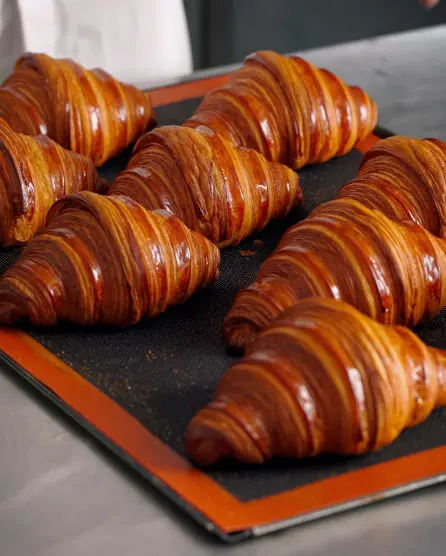
- PRO #7 Croissant
The classic croissant, from dough to bake. The class page names the goal: you leave able to "laminate a croissant that opens honeycombed".
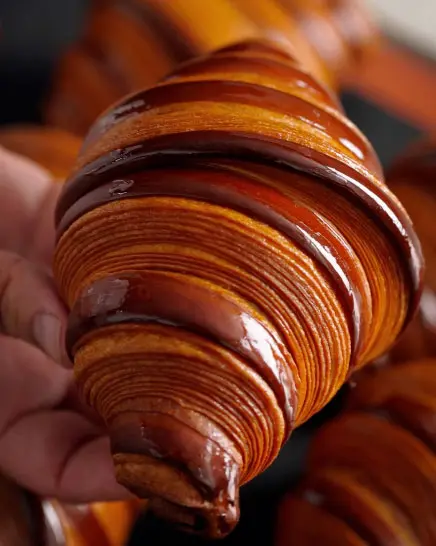 PRO #8 Bicolor Chocolate Croissant
The croissant pushed a second time, into a two-tone chocolate version. How bicolor lamination works in general is explained below.
After the croissant, lesson #9 Tropic Pineapple Pastry takes the lamination into a fruit pastry.
Why the croissant comes seventh
"That order is the method. Lamination is far easier to control once you can read a dough that has fermented properly, so the croissant lessons assume the ferment work sitting behind them. Nothing here is a shortened version."
Gronda class page
The full class, in bakery order
- Introduction FREE
- #1 Sourdough 101 FREE
- #2 Poolish 101 FREE
- #3 Sourdough Baguette FREE
- #4 Seeds & Cereal Pavé FREE
- #5 T80 Flour Bread PRO
- #6 Couronne Bordelaise PRO
- #7 Croissant PRO
- #8 Bicolor Chocolate Croissant PRO
- #9 Tropic Pineapple Pastry PRO
- Video
- 1 hr 50 min HD
- Recipes
- 10
- Level
- Advanced
- Audio
- Spanish (original voice)
- Subtitles
- English, French, German, Spanish, Italian
- Watch on
- iPhone and Android app, or in the browser at gronda.com
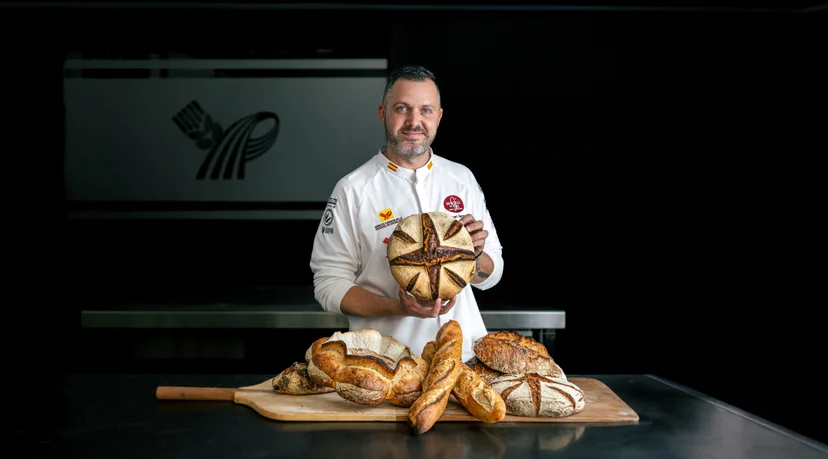 Watch the free introduction on gronda.com
See the whole class: Brilliant Recipes on Bread & Viennoiserie Classics
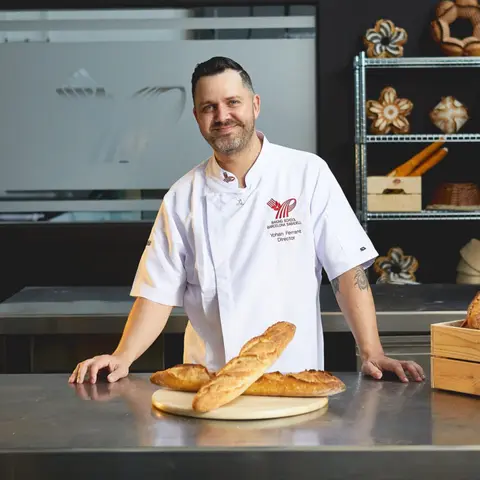
Your teacher: Yohan Ferrant
Yohan Ferrant is a French baker and the Head of the Baking School Barcelona Sabadell, run by the Guild of Bakers of the Province of Barcelona (HostelCo 2026 speaker page). He started in a bakery near his childhood home at thirteen and has worked more than two decades since, in organic bakeries in Paris and in established houses in London. He teaches internationally, from the French INBP to the Japan Institute of Baking (Gronda class page).
His book Oh Là Là! A Practical Guide to Creative Bakery and Viennoiserie is bilingual Spanish and English and covers 45 products step by step (Kitchen Arts & Letters: Oh Là Là!, So Good magazine on Oh Là Là!).
Competition results listed on his Gronda profile
- Bronze Medal, Best of Tokyo, Mondial du Pain
- Best World Organic Bread, Mondial du Pain
- Bronze Medal, Mondial du Pain
- Gold Medal, French Selection
Source: Yohan Ferrant on Gronda. 5.6k followers on Gronda.
"Good bread is mostly about time, the ingredients are simple, the patience is not."
Yohan Ferrant
The croissant numbers, checked against the sources
None of the ten pages Google ranked highest for this search on 6 October 2026 publishes its temperatures. Here they are in the open, from the bakery references we read that day. Where sources disagree, we show the overlap and link each one. Yohan's own formula and fold schedule are in the lessons.
Temperature map
- Dough resting in the fridge4 °C / 40 °F, 8-24 hBAKERpedia, Croissant
- Workroom10-20 °C / 50-68 °FBAKERpedia, Croissant
- Butter block at lamination13-16 °C / 55-61 °FKing Arthur Baking, Laminated dough, Brod & Taylor, How to level up your lamination, Physics Today, The fat in a perfect croissant
- Dough after mixing22-25 °C / 72-77 °F, then chilledBAKERpedia, Croissant
- Proof, 75-80% humidity24-27 °C / 75-80 °F, about 2 hWeekend Bakery, BAKERpedia, Croissant
- Tourage (dry) butter melts36-38 °C / 97-100 °FCremo, Tourage butter specification
Red mark: ordinary butter starts to melt at about 32 °C / 90 °F (Wikipedia). Everything before the oven stays left of it.
Bake hot: about 200-220 °C / 390-430 °F, often lowered after the first 10-15 minutes (BAKERpedia, Croissant, Le Cordon Bleu, King Arthur Baking, Baker's Croissants). Egg-wash twice: thinly after shaping, again just before the oven (Weekend Bakery).
How many layers your folds make
Lock the butter into the dough and you have one butter layer. A single (letter) fold stacks the packet three high, a double (book) fold four high. So the butter layers are 3 to the power of your single folds times 4 to the power of your double folds. Where two dough faces meet they fuse, so a packet always holds one more dough layer than butter layers. In the drawings below, gold is butter and beige is dough.
Layer counts by fold schedule (our arithmetic). Butter thickness assumes a 3.5 mm sheet (Puratos) with 25% butter (BAKERpedia).
| Folds | Butter layers, envelope lock-in | All layers | Butter layers, English lock-in | Each butter layer |
|---|---|---|---|---|
| 2 singles | 9 | 19 | 18 | 97 µm |
| 1 double + 1 single | 12 | 25 | 24 | 73 µm |
| 2 doubles | 16 | 33 | 32 | 55 µm |
| 3 singles | 27 | 55 | 54 | 32 µm |
| 1 double + 2 singles | 36 | 73 | 72 | 24 µm |
| 4 singles | 81 | 163 | 162 | 11 µm |
Why do recipes say 27, 54 or 81 for the same three single folds? They count different things: 27 butter layers after an envelope lock-in (Weekend Bakery, Le Cordon Bleu), 54 fat layers after an English lock-in (BAKERpedia), or the whole dough-butter-dough packet multiplied, 3 × 27 = 81.
More folds are not better. America's Test Kitchen found three turns ideal; beyond that the butter gets so thin the dough absorbs it (ATK). Food scientists describe finished croissant layers of about 100-200 micrometres (Physics Today).
Two published formulas in baker's percentages
Flour = 100. Percentages computed by us from BAKERpedia's commercial formula and Weekend Bakery's home recipe after Hamelman.
| Ingredient | BAKERpedia, % | Weekend Bakery, % | Weekend Bakery, grams |
|---|---|---|---|
| Flour | 100 | 100 | 500 g T55 |
| Water and milk | 54.7 (water) | 56 | 140 g water + 140 g milk |
| Sugar | 10.2 | 11 | 55 g |
| Salt | 1.7 | 2.4 | 12 g |
| Yeast | 3.9 | 2.2 (instant) | 11 g |
| Butter in the dough | - | 8 | 40 g |
| Butter to laminate | 51.2 | 56 | 280 g |
The laminating butter is about half the flour weight, which is roughly a quarter of the whole dough. Flour: medium strength, about 10-11.5% protein; all bread flour makes croissants heavy (BAKERpedia, Dough lamination, Weekend Bakery FAQ).
Which butter
- By law, butter in the EU needs only 80% milk fat and may hold 16% water (EU Regulation 1308/2013).
- For lamination, bakers ask for 82% fat or more; less water means crisper, more defined layers (Le Cordon Bleu, King Arthur).
- Tourage (dry) butter melts at 36-38 °C instead of 28-34 °C, which buys time on the bench and in the proofer (Cremo).
Why it all works: in the oven the water in dough and butter turns to steam and pushes the layers apart, and where the butter was an air pocket stays (BAKERpedia, Croissant, FoodCrumbles, croissant science). That is the honeycomb.
Why are my croissants flat, greasy or bready?
Ten common faults, with the cause and the fix.
| What you see | Cause | Fix | Source |
|---|---|---|---|
| Butter pools on the tray in the oven | Under-proofed, or proofed too warm | Proof longer, until the croissants wobble when you shake the tray; keep the proof under 27 °C | Weekend Bakery, Frequently asked croissant questions, Weekend Bakery |
| Butter breaks into shards while rolling | Butter too cold | Let the block reach 13-16 °C; do not chill more than about 45 minutes between folds | Brod & Taylor, King Arthur Baking, Laminated dough |
| Dense, greasy pastry | Butter too warm, so it melts into the dough | Rest the dough about 30 minutes in the fridge between folds; work in a room under 20 °C | Brod & Taylor, BAKERpedia, Dough lamination |
| Bread-like crumb, no layers | Pressing too hard and working too long, so the butter warms | Roll with even, light pressure and put the dough back in the fridge as soon as it resists | Weekend Bakery FAQ |
| Dough shrinks back as you roll | Gluten is tense | Rest it covered in the fridge for 10-20 minutes | Weekend Bakery FAQ |
| Tight, doughy centre | Under-proofed | Proof until clearly larger and wobbly | Le Cordon Bleu, Weekend Bakery |
| Collapsed croissant, blurred layers | Over-proofed | Bake earlier, at the first wobble | Le Cordon Bleu |
| Layers do not lift | Over-rolling compresses them | Stop at the target thickness, do not keep rolling | Le Cordon Bleu |
| Big hollow gaps inside | Dusting flour left between the layers | Brush off the flour before every fold | Brod & Taylor |
| Croissant splits open in the oven | Poor layering plus under-proofing | Even folds, then a full proof | Weekend Bakery FAQ |
How a bicolor croissant is laminated
A bicolor croissant is the plain laminated dough with a thin coloured dough sheet on top. One published professional method: mix 20 g of black cocoa powder into 500 g of the croissant dough (Puratos), roll it to 1.5 mm, lay it on the laminated dough after the last fold and sheet the stack to 3.5 mm before cutting (Puratos). Others enclose the butter once and give two double folds (IRCA). Yohan's version is lesson #8 Bicolor Chocolate Croissant.
Croissants chefs shared on Gronda
Laminated pastries from Gronda's community collection "Croissants & Viennoiserie", each with its own recipe.
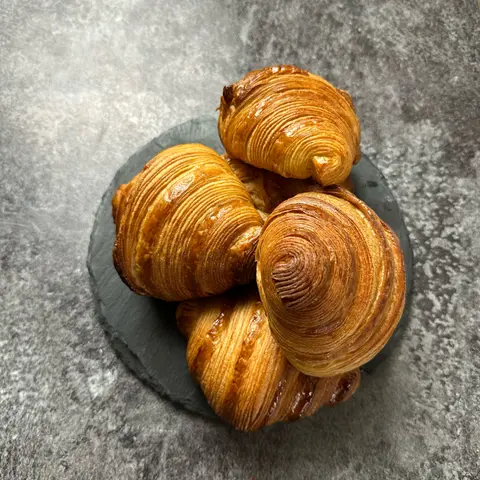 French Croissant
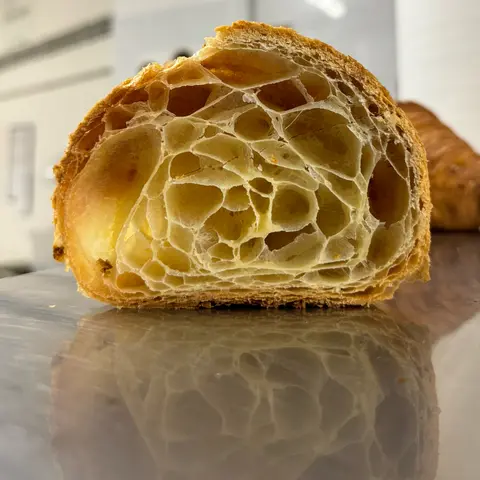 Croissant: Lamination Technique
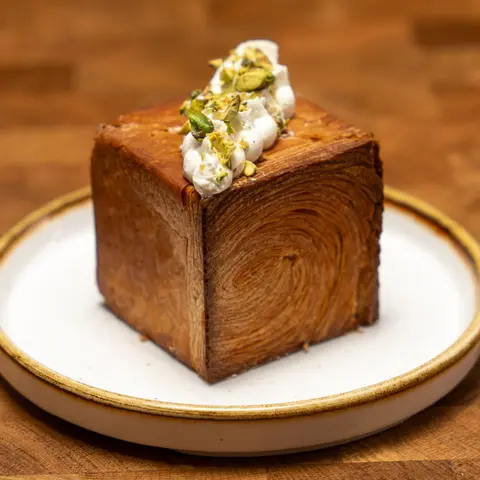 Croissant Cube
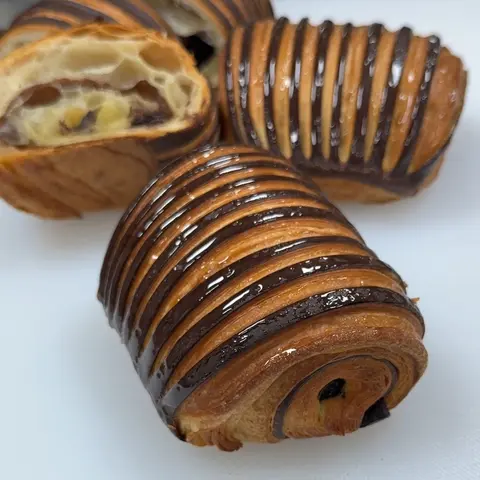 Bio Color Pain Au Chocolat
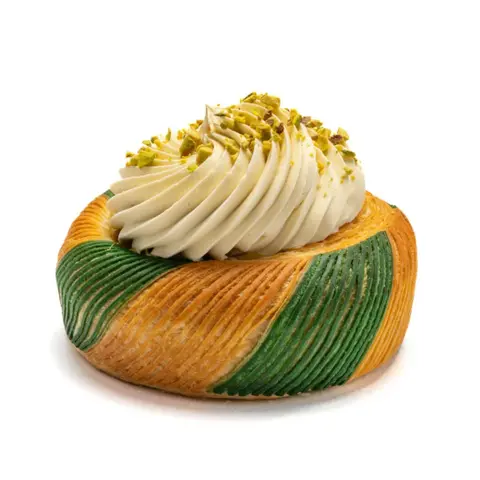 Pistachio Croissant Danish
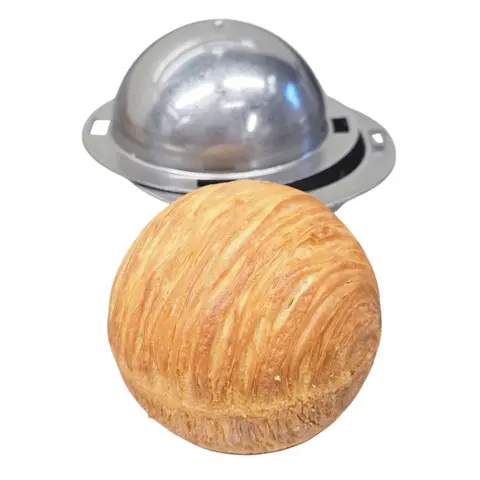 Sphere Croissant
What members say about Gronda
These are reviews of the Gronda app as shown on gronda.com, not reviews of this class. Gronda has 4.8 stars from 7,552 ratings on the US App Store (checked 6 Oct 2026).
"Gronda has excellent content from extremely talented chefs. I absolutely insist that all in house culinary personnel have Gronda on their phone. It is a valuable learning tool."
Markus
"Overall I find this app to be very helpful in connecting me to chefs that I typically would never know of or meet. It is definitely a great medium to learn more of the inside of the high end restaurant world. The masterclasses are good in novelty."
Angel
"This app has the most amazing content. I'm a home cook, love preparing new and exciting recipes. This app is great to gather ideas and prepare a different meal from the usual!"
Lucas, App Store
"Great way to research and try new techniques. Such a fantastic app for every kind of level in cooking."
Riva de G.
Price, trial and other online croissant classes
Gronda PRO
€4.99/month on the annual plan, billed once a year, with a 7-day free trial. Or €9.99/month paid monthly.
Includes both croissant lessons, the full 9-lesson class and every other masterclass (70+), plus the recipe library.
No payment due now. After the 7-day trial: €4.99/month on the annual plan (billed once a year) or €9.99/month paid monthly. Exact pricing depends on your platform and region and is shown before checkout. Cancel anytime in your account settings.
Other ways to learn croissants online, prices as published on 6 October 2026
| Option | Price | What you get |
|---|---|---|
| Coyle's Bakeshop | Free | 4 pre-recorded sessions with Rachael Coyle, owner of Coyle's Bakeshop in Seattle |
| King Arthur Baking | USD 40, one-off; sales are final | One on-demand croissant class, viewable for at least a year |
| Molly J Wilk | USD 279, one-off | One croissant course in 13 modules, lifetime access |
| Gronda PRO | €4.99/month (annual) or €9.99/month | Two croissant lessons inside a 9-lesson bread and viennoiserie class, plus every other Gronda masterclass |
Questions before you start
Is the class in English?
The audio is Spanish, Yohan's original voice, with subtitles in English, French, German, Spanish and Italian.
Are the croissant lessons free?
No. Lessons #7 Croissant and #8 Bicolor Chocolate Croissant are PRO. The 7-day free trial of the annual plan unlocks them, together with every other masterclass.
Is it for beginners?
Gronda rates the class Advanced. The croissant lessons build on the ferment and bread lessons before them, so if laminated dough is new to you, start with lesson #1 and work through in order.
Do I get the recipe?
Yes. Every masterclass comes with its own recipes; this class lists 10.
Where can I watch?
On the Gronda app on iPhone and Android, or in your browser at gronda.com. Start on one, pick up on the other.
How do I cancel?
If you subscribed through the App Store or Google Play, cancel in your phone's subscription settings. If you subscribed on gronda.com, cancel in your account settings. No fees, no calls.
Is the croissant French or Austrian?
Both. Most historians trace it to the Austrian kipferl (Institute of Culinary Education); the laminated yeast-dough croissant is French, with the first recipe usually dated to 1915 (ICE).